Production efficiency is critical for any company operating in the poultry processing industry. In this article, you will learn how to boost your production line efficiency using advanced NOMA machinery that guarantees the highest quality of poultry meat. You will understand how injection and vacuum tumbling technologies optimize processing while protecting the natural texture, flavor, and appearance of delicate fillets.
In this article, you will learn:
Increasing poultry processing efficiency without sacrificing quality requires the use of precision technologies that minimize human error. The key lies in automating meat enhancement processes. In NOMA’s portfolio, the MH-SAS (Servo Automatic System) injector series plays a pivotal role. These machines are engineered specifically for advanced injection processes of both bone-in and boneless meat, as well as delicate chicken breast fillets.
By utilizing a servo-driven head and conveyor system, these machines ensure high repeatability of injection levels, at both low (up to 10%) and high (over 100%) values. This allows manufacturers to boost production line efficiency while preserving the natural structure of the meat, as the injection occurs without unnecessary squeezing out of the brine.
Modern technologies for poultry processing focus primarily on integrating the injection and tumbling stages.
To ensure poultry meat quality at every single stage, total parameter control is essential. The SCADA system offered by NOMA enables real-time monitoring of injectors, tumblers, and brine mixers. It records data such as batch temperature, vacuum levels, drum rotation speed, and brine pressure. This allows production managers to quickly detect anomalies and optimize workflows, translating directly into product repeatability and safety.
Hygiene is equally paramount. Cleanetic washing lines, including tunnel container washers (MP) and buggy/trolley washers (MWF), ensure highly effective washing and sanitization, which is key to meeting HACCP and GHP standards in poultry plants.
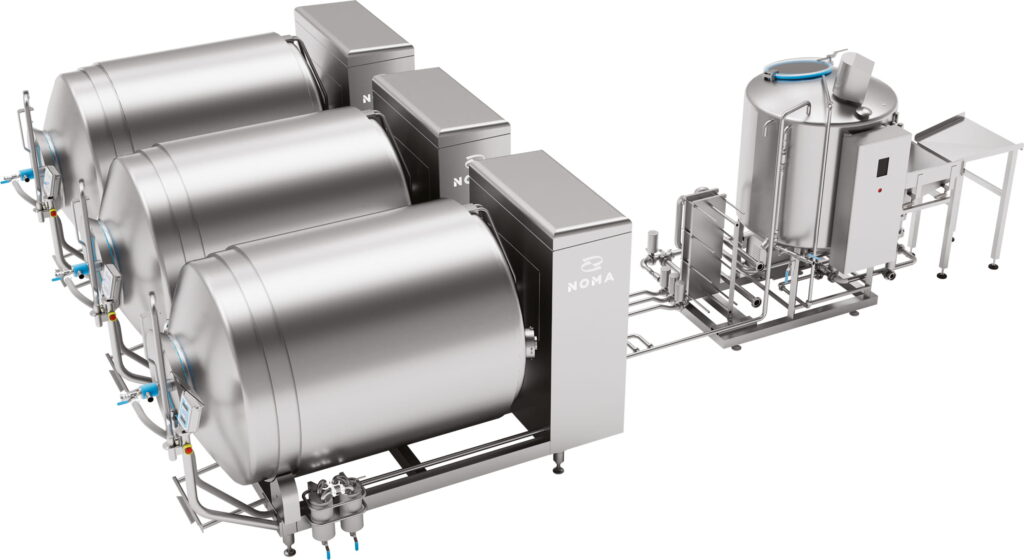
The SAS (Servo Automatic System) technology in NOMA injectors synchronizes the conveyor drive with the injection head drive, enabling high-precision injection without damaging delicate poultry tissue. Additionally, tumblers equipped with a cooling jacket maintain the preset tumbling temperature, which improves protein binding, stabilizes product color, and guarantees production repeatability.
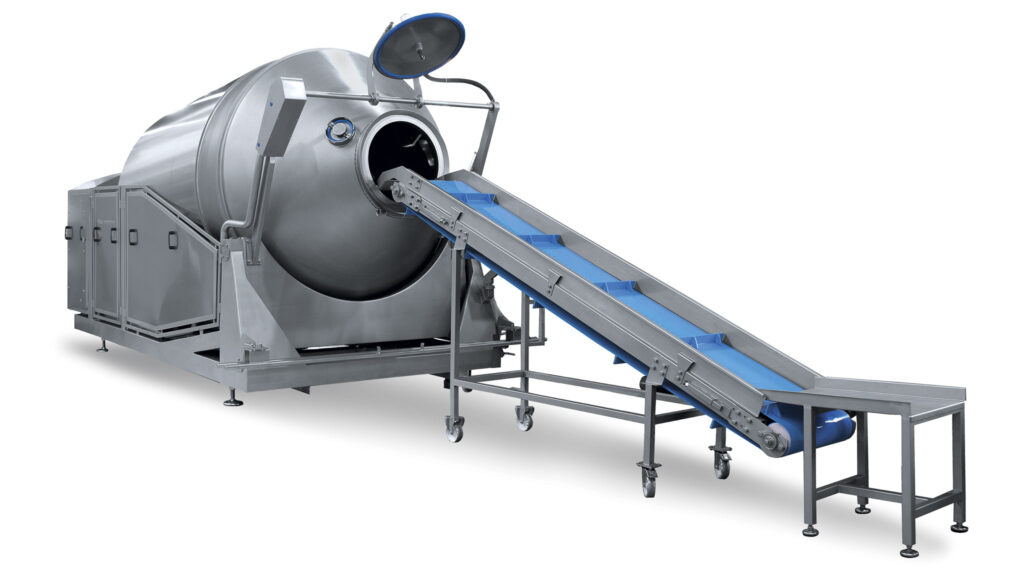
The key is to implement machinery designed to minimize yield losses. NOMA vacuum tumblers feature an innovative blade system that reduces yield losses and ensures perfect tumbling of even the most delicate meat parts. Furthermore, integrated weighing systems within the production lines allow for precise batch control.
You need to control raw material temperature, brine pressure, and vacuum parameters. In NOMA machinery, an entire system of sensors and microprocessor controllers handles this automatically. Additionally, the entire process sequence can be logged using the SCADA system, which monitors factors like brine temperature in the injectors and batch temperature in the tumblers.
Yes, absolutely. For example, automated NOMA lines (such as integrated injection and tumbling lines) reduce the need for manual handling, lower the operator labor hours required per production run, and simultaneously shorten processing times. Furthermore, a properly tailored technological process for tumblers equipped with a defrosting system (MAH-PS/D) allows defrosting and tumbling to be combined in a single machine, saving both time and floor space in the plant.
Follow the latest events and changes in our company – stay up to date with what’s important.